Publications by Dr. Elena Jurasaite-O’Keefe
Dr. Elena Jurasaite-O’Keefe, an Associate Professor at St. John’s University, NYC, USA, is an author of international comparative publications focused on how teachers learn in informal settings. Previously, she has worked as a Senior Research manager at the International Baccalaureate Organization. Earlier she worked as an Assistant Professor of Education at Hofstra University, NY, USA, lead an international child development program at the Open Society Fund-Lithuania, worked as a school principal, and taught English as a foreign language. She holds two doctoral degrees – from Siauliai University, Lithuania and University of Michigan, USA.
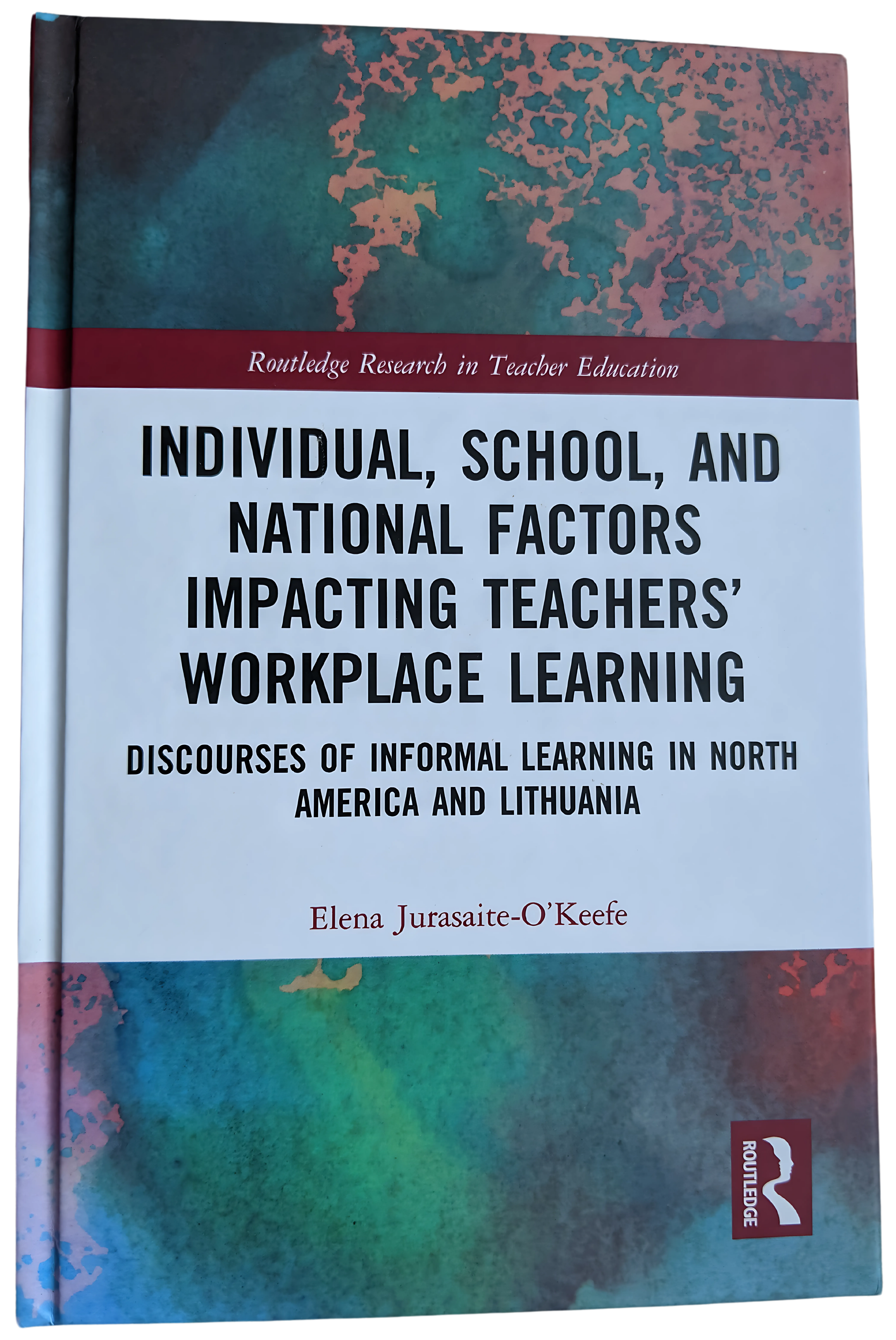
INDIVIDUAL, SCHOOL, AND NATIONAL FACTORS IMPACTING TEACHERS’ WORKPLACE LEARNING
DISCOURSES OF INFORMAL LEARNING IN NORTH AMERICA AND LITHUANIA
How do practitioners (teachers, in this case) maintain their quality of work and grow professionally?
How do they learn every day in their workplace?
In this book, eleven teachers from three schools in two countries (the United States and Lithuania) invite us to follow their day-to-day professional learning. It is valuable to parallel these two countries’ professional learning cultures because features of informal learning that are going to be traced in this study can be better illuminated through their comparison in the national settings that are culturally different due to their political histories and socio-economic backgrounds and yet tend to become more and more similar because of globalization. Rich descriptions derived from extensive observations and detailed analysis of in-depth individual and focus group interviews immersed in the context of national educational policies highlight distinctive patterns of learning. Various modes of discourse analysis (Kress, 2011) at three layers–individual, schools’, and district/national educational systems’ layers that fit into each other (like a nesting doll) starting with the smallest (individual), which carries its features to, interacts with, and co-creates the larger (school) layer, then both fitting into, interacting with, and co-creating the largest one (district/national) co-construct teacher learning as a multi-dimensional socio-cultural process (Jurasaite & Rex, 2013).
Originally told by participants in three languages and representing three different ethnic cultures, teachers’ stories unveil profound problems that trouble education systems in the two countries. For example, specific interactional patterns revealed the role that school architecture plays in supporting or impeding teacher workplace informal learning. Another distinct finding pertains to developing a typology of informal learners, which started shaping up through the analysis of teachers’ reflective journals. It holds highly important implications for the research on informal workplace learning in any professional field: once confirmed by more studies, it will allow for a deeper understanding of informal learners’ variability, which could be applied for developing learning environments that will be better tailored to adult learners’ needs.
Places and spaces where teachers can communicate and collaborate, read and discuss, share and exchange seem to directly stimulate their informal learning.
Recent Publications
Jurasaite-O’Keefe, E. (2026). Unlock Your Full Potential with a Growth Mindset: A Practical Guide for Teens to Build Life Skills, Transform Your Thinking, and Overcome Life Challenges.
Jurasaite-O’Keefe, E. (2022). Individual, School, and National Factors Impacting Teachers’ Workplace Learning: Discourses of Informal Learning in North America and Lithuania. Taylor & Francis.
Jurasaite-O’Keefe, E. & Zak, A. (2022). Informal learning in study abroad programs: A grounded theory construction. The Journal on Excellence in College Teaching, 33(1), 5-30.
Jurasaite-O’Keefe, E. (2021). Developing international-mindedness in the middle school: School and family factors. Research in Middle Level Education Online (in press).
Jurasaite-Harbison, E., & Rex, L. A. (2013). Teachers as informal learners: workplace professional learning in the United States and Lithuania. Pedagogies, 8 (1), 1-23.
Jurasaite-Harbison, E. (2012). Workplace learning in informal contexts: Transnational comparison of teacher professional growth in Lithuania and the United States. In Mark Ginsburg (ed.) Preparation, Practice, and Politics of Educators: Problems and Prospects in Comparative Perspective. Rotterdam, Netherlands: Sense Publishers.
Mark Ginsburg (ed.) Preparation, Practice, and Politics of Educators: Problems and Prospects in Comparative Perspective. Rotterdam, Netherlands: Sense Publishers.
Jurasaite-Harbison, E., & Rex, L. A. (2010). School cultures as contexts for informal teacher learning. Teaching and Teacher Education, 26, 267-277.
Jurasaite-Harbison, E. (2009). Teachers’ workplace learning within school cultures community in the United States and Lithuania. Journal of Workplace Learning, 21(4), 299-321.
Jurasaite-Harbison, E. (2009). Learning in and from practice: Opportunities and implications for teachers’ learning in informal contexts in Lithuania and the United States. Saarbrucken, Germany: Verlag Dr. Muller Aktiengesellschaft & Co. KG.
Jurasaite-Harbison, E. (2007). Teachers as learners: Individual aspects of informal professional learning. Teacher Education (Mokytoju Ugdymas), 9, 44-60.
 Elena's World of Children Books